1. Main Functions of the Medium Voltage Control Center
These centers basically perform three main functions:
- Control: Opening and closing circuit breakers, operating motorized disconnectors, or changing transformer tap positions.
- Monitoring: Real-time observation of line current (A), voltage (V), active-reactive power (kW/kVAR), and frequency (Hz) values.
- Protection: In case of a fault (overcurrent, short circuit, etc.), the system is de-energized within seconds via protection relays.
2. Equipment Found in the Control Center
When you open the cover of an MV control panel, the main components you will see are:
- Secondary Protection Relays: This is the brain of the system. It has a digital structure. It detects faults and sends a “trip” (open) signal to the circuit breaker.
- Mimic Diagram: A visual single-line diagram on the panel that represents the switchyard using symbols. The open or closed status of each circuit breaker is monitored through illuminated indicators.
- Control Switches: Spring-loaded switches used for manually opening and closing circuit breakers (such as L-0-R switches).
- RTU (Remote Terminal Unit) / Communication Modules: Devices that digitize all field data and transmit it to the central SCADA system.
- Power Analyzers: Precision meters that measure the amount and quality of electrical energy consumed.
3. Why is the “Control” Section Separate?
In MV cells, the “Primary” (High Voltage) and “Secondary” (Low Voltage/Control) sections are physically separated by steel sheets.
- Safety: The operator does not come into contact with 34.5 kV busbars while making settings or reading data.
- Insulation: Sensitive electronic devices (relays, computers) are protected from the electromagnetic field generated by high voltage.
4. Modern Control Centers: SCADA and Automation
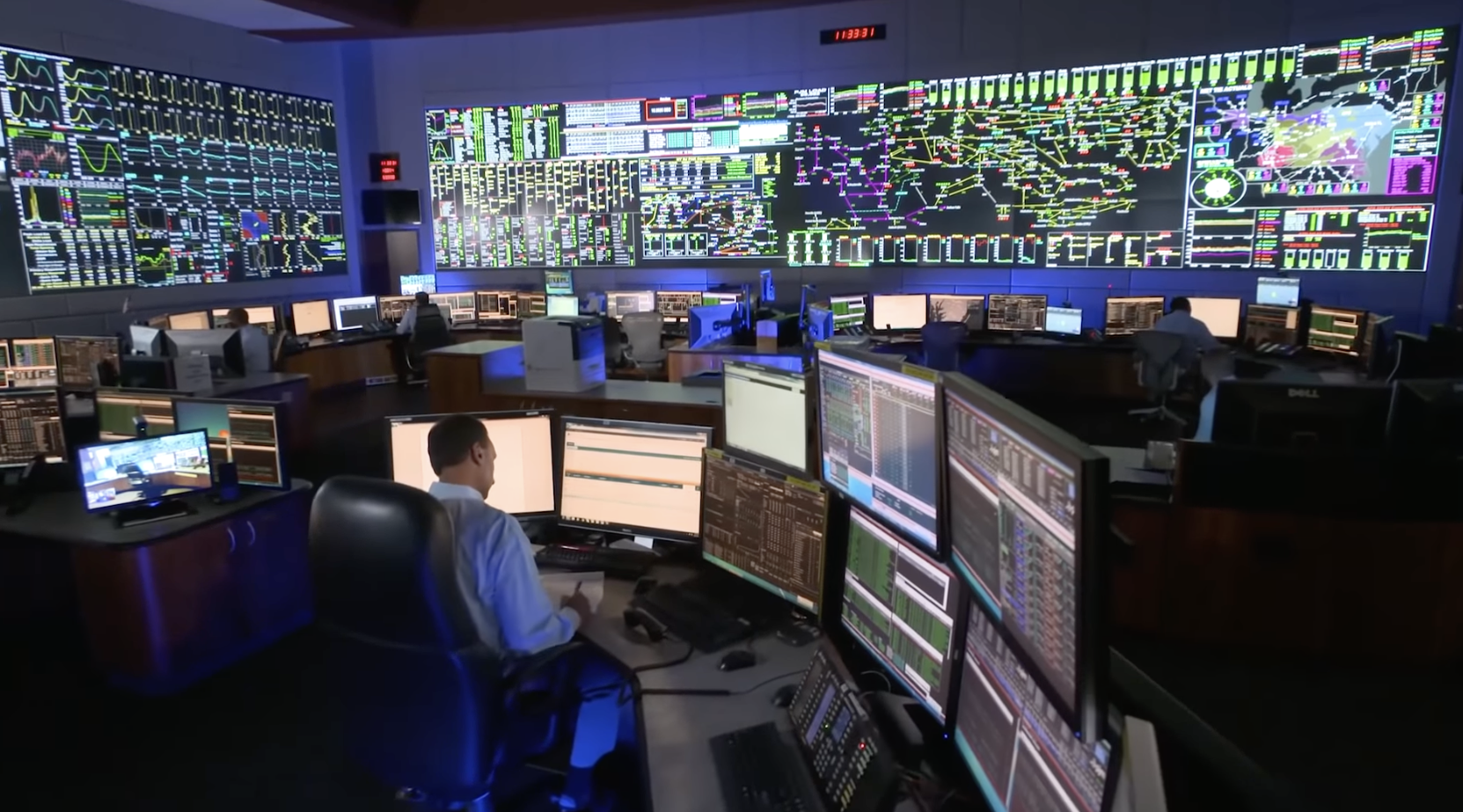
Many facilities now use “Remote Control” (SCADA) instead of “Local Control”.
- Remote Operation: The operator can close a circuit breaker with a mouse from a control room located kilometers away.
- Event Logging: In the event of a fault, relays record data at millisecond-level resolution. This makes it easy to determine answers to questions such as “What caused the fault?” or “Which line tripped first?”
- Interlock: With software-based interlocks, if the operator attempts a dangerous switching operation by mistake, the system does not allow it.
5. Things to Consider
- DC Power Continuity: Control systems are usually supplied by a battery-rectifier group. Even if the power is cut, this DC energy must never be depleted so that the circuit breaker can still trip.
- Cable Labeling: There are hundreds of thin cables in a control panel. Proper labeling according to the project significantly reduces fault-finding time from hours to minutes.
- Cybersecurity: In SCADA-connected centers, special firewalls must be used to prevent external interference.